
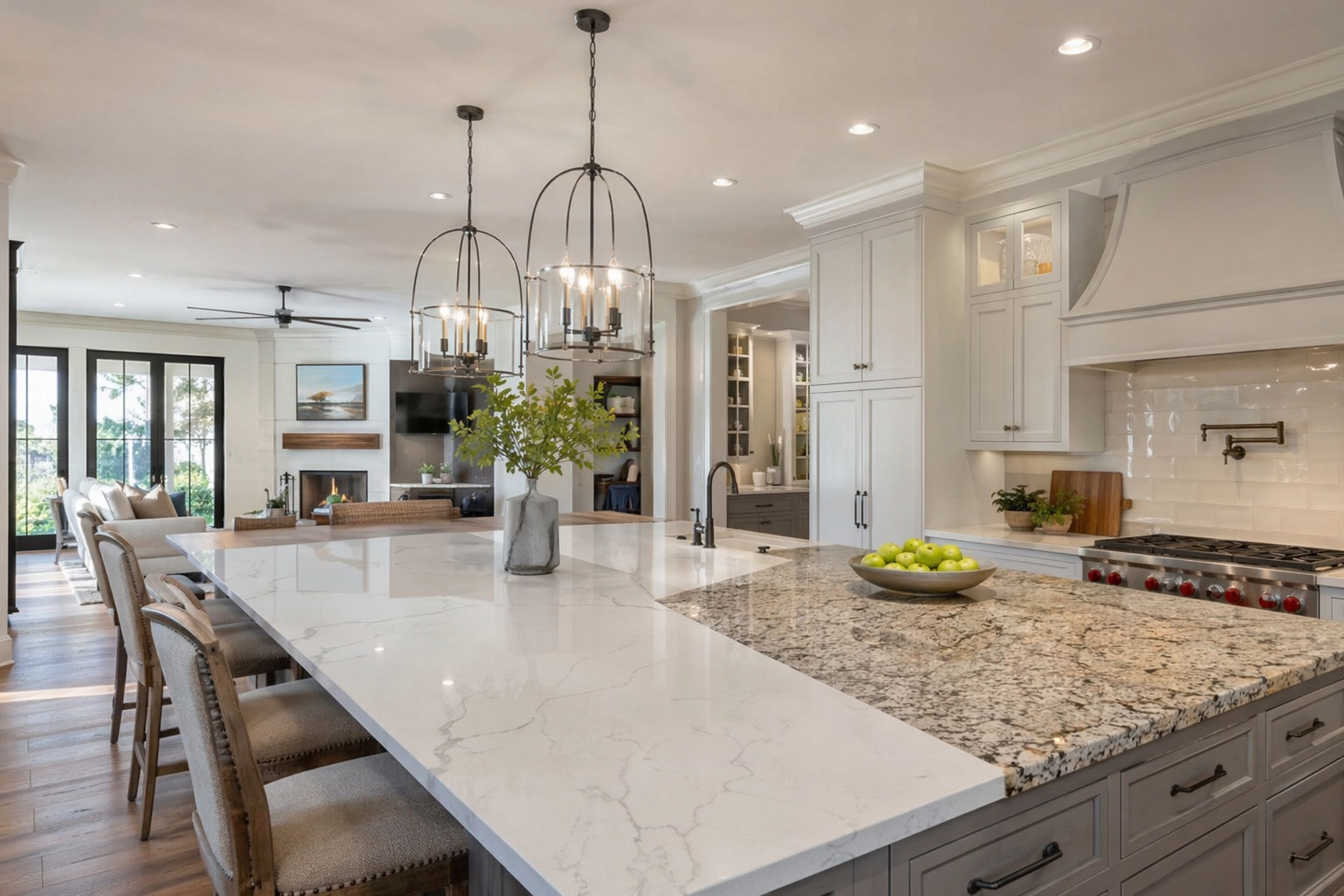
Introduction
Picking the right countertop material will change how your kitchen looks, feels, and works every day. For people in Charlotte, you often choose between two high-quality options: granite countertop or quartz countertop. Both options have good points, but what is best for you depends on your style, how much care you want to put in, and how you use your kitchen. As the custom countertops in Charlotte experts, we help local people make this choice because the counters are more than just part of the design. They are one of the most important decisions you will make when you change your kitchen. In terms of durability, both granite countertop and quartz countertop offer excellent strength and long-lasting performance. Granite countertop is highly resistant to heat and scratches, while quartz countertop is non-porous and stands up well to stains and chips. Deciding between them comes down to which qualities suit your everyday kitchen needs best.
Understanding Quartz and Granite Countertops in Charlotte
In Charlotte, the quartz countertop and granite countertop are still a popular choice for upgrading kitchens. Homeowners look for surfaces that look good, last long in daily life, and keep their value over time. Because of this, these stone countertops are often picked for kitchen remodeling. When comparing maintenance, quartz countertops are generally easier to maintain than granite countertops because quartz is non-porous, resists staining, and does not require regular sealing, whereas granite is porous and needs routine sealing and more careful cleaning to prevent stains.
The biggest difference is in what they are made from. Granite is a natural stone that comes right out of the earth as a big slab. Quartz is an engineered stone. It is made from natural quartz mixed with resin binders during a careful process. At MyNewSurface, we help people in the area compare the two by focusing on style, how much work it is to keep clean, and what is popular now for remodeling plans.
What is Quartz? Characteristics, Composition, and Uses
Quartz is a type of engineered stone that is popular for kitchen countertops. It is made by mixing natural quartz with resin binders and color pigments. This mix usually has about 90 to 93 percent natural quartz. The final result is a dense surface that is not a porous surface, so it does not soak up spills and is strong for daily use. Compared to granite, quartz offers several advantages, such as being non-porous, which makes it more stain-resistant and easier to maintain. Quartz also provides a uniform appearance and comes in a wider variety of colors and patterns. However, some cons include that quartz can be less heat-resistant than granite and may be more expensive. Granite, on the other hand, appeals to those who prefer a natural stone look and higher heat resistance, but it requires sealing and more regular maintenance because it is a porous surface.
Since quartz is made in a factory, each slab has a consistent design. You will find a wide variety of colors to match your space, from soft neutrals to bold shades. Some styles also look like marble countertops or natural stone. This is one thing that makes quartz countertops different from granite, which can look very different from piece to piece. When it comes to cost, quartz and granite countertops are generally priced similarly, though exact prices can vary depending on the specific style and installation. Typically, quartz may have a slightly higher price range due to its manufacturing process and consistency in design, but both materials are considered premium countertop options.
In Charlotte, people pick quartz countertop for many kitchen countertops, kitchen islands, and bathrooms. They do this because it offers little maintenance. MyNewSurface often suggests getting a quartz countertop if you want a simple look, want help with easy clean-up, and need a product that fits well with modern ideas and does not take a lot of work to keep looking good. When comparing quartz and granite, quartz countertop is generally more stain resistant than granite, making it an even better choice for busy kitchens and bathrooms where spills are common.
What is Granite? Characteristics, Origins, and Features
Granite is a 100 percent natural stone. It forms when magma cools down over time. People take it from the earth in big pieces. After that, they cut each granite slab to use for things like stone countertops. Each granite slab has its own mix of minerals, so every slab looks different. While granite is valued for its unique, natural patterns and colors, quartz generally offers more variety in colors and patterns because it is engineered using pigments and resins, allowing for a broader range of design options.
This natural origin gives granite movement, change, and natural veining that you cannot copy. A granite countertop is known for good heat resistance. But, it also has a porous surface. So, it needs regular sealing to help stop stains. When deciding between quartz and granite for your home, consider factors such as durability, maintenance requirements, appearance, and heat resistance. Granite offers unique natural patterns and excellent heat tolerance but will need periodic sealing due to its porous nature, while quartz is non-porous and often easier to maintain but does not have the same natural veining.
In Charlotte, granite works well for kitchen countertops, statement islands, bathroom vanities, and also in some outdoor kitchens. For a full breakdown of what to expect to spend, see our granite countertops cost guide. MyNewSurface supports people who want bold natural beauty. The team helps you know where granite slab works best, and where its extra care matches your specific needs. While granite offers exceptional durability and unique beauty, it does have some drawbacks. Granite countertops require regular sealing to prevent stains, and the stone can be prone to chipping or cracking if subjected to heavy impact. Similarly, quartz countertops, though resistant to staining and less maintenance-intensive, can be sensitive to excessive heat and may discolor over time with direct sunlight exposure.
Key Differences Between Quartz and Granite Countertops
When you look at natural stone countertops and engineered stone surfaces, you can see a few main things that make them different. These are how they look, how easy they are to take care of, and how they be in your home. A quartz countertop gives you the same look everywhere. It needs low maintenance and does not stain easily. A granite countertop gives you a lot of variety that is hard to match. You see deep colors, and it can handle high heat better.
If you live in Charlotte and want new stone countertops, you should think about your routine, how you cook, and what style you like most. MyNewSurface helps people choose the right stone surfaces every day. In the next parts, we will talk about how natural stone and quartz countertop types look, how strong they are, how much work it takes to keep them up, and what you will pay. This will help you pick the best one for your new countertops.
Visual Appeal: Colors, Patterns, and Customization
Style is often what helps pick the winner first. Granite is known for its natural beauty. You can notice the visible movement and natural veining, which makes every slab look original. Quartz is not the same. It gives you a cleaner look with more control over the pattern. This helps make a more even finish and makes it easy to keep the look even across big spaces.
If you want design options that you can count on, quartz gives a wide variety of colors since it’s made by people, not by nature. If you want to bring out natural stone at its best, granite is hard to match. This is one of the easiest ways to see the good and bad sides of picking a quartz countertop instead of natural stone granite.
- Granite stands out for unique tones and natural veining that is one-of-a-kind.
- Quartz gives you a wide variety of colors and more even patterning.
- Quartz can look like marble countertops with a consistent design.
- Granite often becomes the center of attention on a kitchen island.
- Both natural stone and quartz countertop can look good with painted or stained cabinets when picked well by MyNewSurface.
Durability and Longevity for Charlotte Kitchens
Both materials are built for daily life, but their strengths differ. Quartz is highly durable and resists scratches, chips, and stains very well. Granite is also durable and can last for decades, even up to a lifetime with proper maintenance. For many Charlotte kitchens, the better material depends on how you cook and clean.
Heat resistance is where granite leads. It can handle hot pans far better than quartz, which can be damaged by excessive heat or thermal shock. Quartz performs better against staining and often edges out granite in resistance to surface damage. Granite can chip or crack because natural stone has weak points.
MyNewSurface helps homeowners weigh these durability tradeoffs before installation.
| Durability Factor | Quartz | Granite |
|---|---|---|
| Scratch resistance | Strong | Strong |
| Chip resistance | Very good | Good, but can chip or crack |
| Stain resistance | Excellent due to non-porous surface | Good when sealed |
| Heat resistance | Lower, use a hot pad | Excellent, handles high temperatures better |
| Maintenance impact | Low maintenance | Needs regular maintenance and sealing |
| Longevity | Decades | Decades to lifetime with care |
Maintenance and Care Requirements
The life of stone countertops depends a lot on proper care. Even the best surfaces need a good routine if you want them to keep their look, color, and work well with time. This is very true in busy Charlotte kitchens. There, you get spills, heat, and people use them all the time.
Quartz is known for being low maintenance. Granite, on the other hand, needs regular maintenance and regular sealing. At MyNewSurface, we help homeowners by showing them the simple steps that will protect each surface. In the next two sections, you will find out about cleaning, stain resistance, and steps that will help your countertops look good for years.
Cleaning and Stain Resistance Compared
If easy upkeep is what you want, quartz is the best pick. It has a non-porous surface. That means it fights stains better. So when you spill coffee, oil, or wine in the kitchen, these will not soak in as fast. Granite, on the other hand, has a porous surface. Spills can be a big issue if the seal wears off.
Cleaning both granite and quartz is easy if you do it the right way. For quartz, you can wipe it with mild soap or an all-purpose cleaner. Granite also needs gentle cleaning. Do not use harsh cleaners because they can wear out the surface protection. Granite needs regular sealing to stay safe, so the homeowner needs to give it more care over time.
For Charlotte homes, MyNewSurface has these tips:
- Wipe up spills fast, especially when you have dark liquids.
- Use mild soap and a soft cloth for cleaning every day.
- Keep up with regular sealing if you have granite.
- Stay away from harsh products that can harm the finish or seal.
Tips for Keeping Quartz and Granite Looking New
Good habits in daily life are more important than using complicated products. Both surfaces can look good for a long time when you protect them from things that can be avoided. Quartz needs extra care when it comes to heat and direct sunlight. Granite needs you to watch out for sealing and the risk of heavy items hitting it.
Think about how your kitchen is used each day. Do you set hot pots on the counter often? Do you want stone surfaces that need little maintenance? These questions help you know which one is better for you—quartz or granite. MyNewSurface gives Charlotte homeowners advice based on what works best, not just on what is popular.
Try these steps for proper maintenance:
- Always use a hot pad or heating pads under hot pots and hot pans when putting them on quartz.
- Clean up spills fast to lower the chance of stains on any stone surfaces.
- Keep quartz out of direct sunlight for long times because uv rays can cause it to lose its color.
- Do not let heavy things hit or drop on the edges or corners.
- Do annual sealing or regular sealing for granite.
- Use cutting boards and do not let things hit stone surfaces extra.
This way, you can keep your counters looking good and make them last longer.
Cost Considerations for Charlotte Homeowners
Price is important, but you also need to think about what you get for it over time. In Charlotte, the cost you pay for new countertops depends on the type of material, how many square feet you need, how the space is set up, and the details of the install. A slab of granite might cost less at first, while the cost of quartz often does not change much between types.
The first price you see is not the whole story. The need for upkeep, the chance that repair will be needed, and how good it looks for years to come also matter. MyNewSurface helps people match what they spend with how they live. This helps you pick what is best for your budget now and for the years ahead.
Comparing Price Ranges: Initial Purchase to Installation
For general budgeting, quartz and granite can overlap, but granite is often the lower starting point. Compiled pricing shows quartz commonly ranging from about $50 to $150 per square foot installed. Granite often falls around $40 to $100 per square foot installed, depending on rarity and visual demand.
Installation also affects the final number. Quartz is more uniform, which can simplify planning and reduce some handling issues. Granite needs expert handling because each slab of granite may have natural weak points, and pattern matching can make installation more demanding. That is why professional installation from MyNewSurface is so important in Charlotte homes.
Here is a quick pricing view:
| Cost Factor | Quartz | Granite |
|---|---|---|
| Typical installed price per square foot | $50 to $150 | $40 to $100 |
| Price consistency | More consistent | Varies by rarity and pattern |
| Installation complexity | Easier due to uniformity | More specialized due to brittleness and variation |
| Maintenance cost over time | Lower | Higher due to sealing needs |
Value, Resale Impact, and Return on Investment
Both materials can help you get a better resale value. People see them as top choices for kitchen surfaces. Granite has a classic and elegant look. It is known as a natural stone with long-time appeal. Quartz is great for those who want something nice but with low maintenance, since it does not need annual sealing. How much money you get back will depend on picking the right one for your market and how your home looks overall.
There is not one perfect choice for everyone. Quartz could be the best choice for younger people or those with families who want an easy, low-maintenance kitchen. Granite is still the top choice if you want natural stone with a strong look and elegant style. MyNewSurface helps people in Charlotte find the right surface by thinking about both design and resale value.
Key ROI points include:
- Granite often gives strong resale value because it has a top spot as a luxury surface.
- Quartz attracts buyers who want a pretty surface but also want low maintenance.
- Quartz is a good fit for new kitchens that have simple, clean lines.
- Granite brings one-of-a-kind character, which can make a kitchen stand out.
- The downsides are clear: quartz does not handle high heat as well, and granite needs ongoing care, like annual sealing.
Conclusion
To sum it up, picking between quartz and granite countertops for your Charlotte kitchen means you need to think about things like how long each material will last, how much care they need, and how they look. Both are strong choices and many people like them for their homes. In the end, you should choose what fits your style, your needs, and how much you want to spend. MyNewSurface is the top surface and remodeling company in Charlotte. We are ready to help you every step of the way. You can count on us to give you advice, put in your counters, and support you after the work is done. Get in touch with us today to see how we can help change your kitchen with the best countertop, made just for you.
Frequently Asked Questions
Which is the better choice for Charlotte’s kitchens: quartz or granite?
For many busy kitchen countertops in Charlotte, a quartz countertop is often easier to manage. It needs low maintenance and it does not stain easily. If you want one of the best materials for heat and want a real natural stone look, a granite countertop is a great choice. MyNewSurface is here to help you pick between these two, so you can choose what fits your routine best.
What are the most significant drawbacks of quartz and granite countertops?
The biggest cons of quartz countertop choices are that they cannot handle a lot of heat and may lose color if they sit in sunlight for too long. When it comes to a granite countertop, the main cons of granite are that you need to seal it often. Also, it is easy for stains to get into the porous surface. MyNewSurface makes sure people know about the cons of granite countertops and cons of quartz countertops before any installation.
How does MyNewSurface ensure professional installation and support in Charlotte?
MyNewSurface gives you expert guidance, local support, and helps at every step when you choose and install kitchen countertops in Charlotte. They talk you through the different surfaces, help with layout problems, and make sure the job is done right. This hands-on way of working is why so many people trust MyNewSurface when it comes to kitchen countertops and remodeling.